
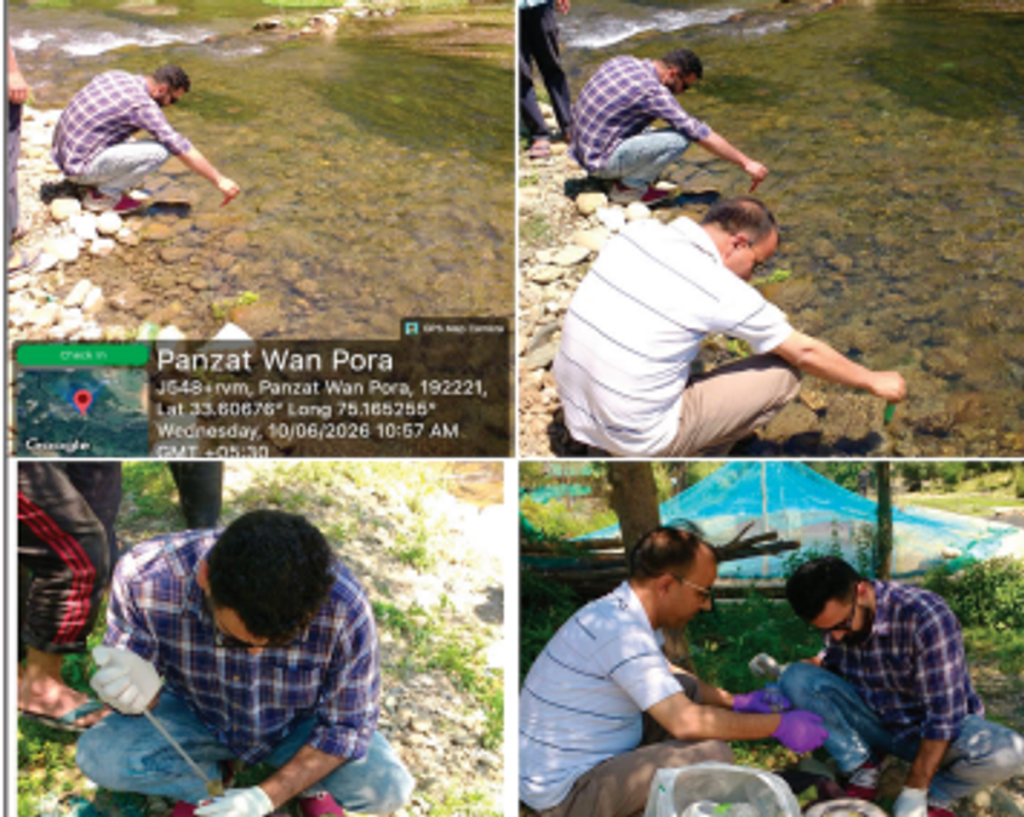
Severe sewage contamination has degraded water quality in the Panzath springs of Qazigund in South Kashmir’s Anantnag district, causing ecological stress, oxygen depletion and disease that triggered the recent mass fish deaths, an expert investigation by the Faculty of Fisheries at SKUAST-K has found. The expert team from SKUAST-K’s Rangil campus in Ganderbal collected water and fish samples last month after large-scale fish mortality was reported to determine the cause and recommend corrective measures. Professor and Head, Faculty of Fisheries, Dr Feroze Ahmad Shah, said the investigation found that the physico-chemical characteristics of water in the lower reaches of the spring had deteriorated because of sewage discharge, siltation and other effluents entering the waterbody. “Our team collected baseline data on water quality and fish health. “We found the aquatic life under tremendous stress, while opportunistic bacterial and fungal pathogens have caused disease in the fish,” Shah told Greater Kashmir , quoting the report. He said pollution had weakened the fish, making them more vulnerable to infection. “The sewage and kitchen waste entering the springs must be stopped immediately. Management issues also need to be addressed,” the report said. It said exposed drinking water pipelines of the Public Health Engineering (PHE) department running across the springs were contributing to algal blooms, aquatic weed growth and water stagnation. “Besides spoiling the appearance of the springs, these pipelines encourage algae and weed growth. The PHE department should relocate them,” the report suggested Shah said SKUAST-K had recently conducted an awareness programme to educate local residents on the scientific management and conservation of the springs. Professor Adnan, Head, Division of Aquatic Environment Management, SKUAST-K, said analysis of water samples confirmed deterioration in water quality, ecological stress and oxygen depletion. The scientists recommended maintaining cleanliness, regulating fish feeding and preventing visitors from throwing food or waste into the spring as part of a long-term conservation strategy. “Overfeeding and indiscriminate disposal of food and waste into the water must be avoided to safeguard fish health,” the report added. Meanwhile, members of the Environmental Policy Group (EPG), led by former bureaucrat Khurshid Ahmad Ganai, former Power Development Commissioner Manzoor Ahmad Salroo and former Chief Conservator of Forests Manzoor Ahmad Tak, visited Panzath and assured residents of support in conserving the springs. “We appreciate the cleaning efforts being carried out regularly by local people. However, the administration, the Irrigation Department and the Public Health Engineering department also need to play their role in conserving this natural treasure,” Ganai said. He said he had taken up the matter with senior officials and suggested preparing a joint conservation plan for the springs and their aquatic ecosystem. Residents have meanwhile continued de-weeding and cleaning drives. “Cleaning alone will not help unless sewage from kitchens and toilets is stopped from flowing into the lower reaches of the springs. Either people must stop it voluntarily or the administration should intervene,” said local resident Abdul Salam. He also urged the PHE department to remove pipelines crossing the springs and relocate them saying they contributed to silt deposition, weed growth and water stagnation. “This is our asset. We must protect it, otherwise future generations will blame us,” Salam said. A preliminary assessment by the Fisheries Department had earlier also linked the fish mortality to untreated sewage, waste accumulation and a suspected bacterial infection. It said prolonged pollution had likely stressed the indigenous Schizothorax population, leaving it vulnerable to opportunistic bacterial and fungal infections. Following the incident, the department treated affected portions of the spring with potassium permanganate and benzalkonium chloride, carried out de-weeding and cleaning operations, and referred the matter to the National Surveillance Programme for Aquatic Animal Diseases for further investigation. Known locally as Panzath Nag, the spring is believed to have given the village its name. The term derives from Paanch Hath – Kashmiri for “five hundred” – because the spring once fed hundreds of smaller water sources, totalling nearly 500 springs in the area. Nearly 45 villages in the Qazigund belt depend on the springs for drinking water, while its rivulet irrigates paddy fields downstream. A government-run trout hatchery and fish sales centre nearby also rely on the spring’s perennial flow. The Panzath incident is the sixth reported case of mass fish mortality in Kashmir in the past six months. Similar incidents have been reported from Nagbal and Andernag springs in Anantnag, Chamgund stream in Kulgam, springs in Zainapora in Shopian, Beehama in Ganderbal and the Martand springs in Mattan, with indigenous Schizothorax species affected in each case.
Source: Read Full Article