
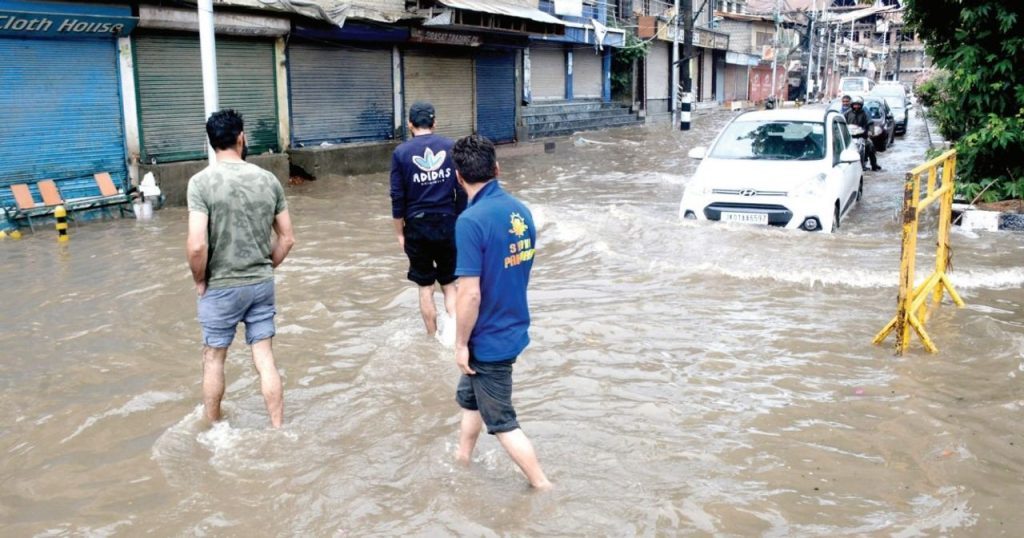
The roads in Jammu and Kashmir summer capital Srinagar get flooded every time there is intense rainfall for a few hours! What raises questions is that inundation of roads is more visible in those areas where new drainage systems and footpaths were constructed under the Srinagar Smart City Project in the last few years. The water-logging problem has become chronic in Srinagar’s Downtown areas which had earlier never witnessed such inundation of roads after rains. It is clear that either the drainage system is choked or there is a flaw in its design and carrying capacity or dewatering pumps are not functioning properly. Whatever the reason in the end it’s people who have to bear the brunt of waterlogged roads after rains. Is it an engineering failure that rainwater overwhelms the existing drainage network? We need to understand that decades ago, rainwater which accumulated on roads used to directly flow in nearby water bodies by gravity. Later when a new drainage system was constructed all these stormwater outlets were plugged and connected to the new drainage system. The entire drainage network in Srinagar is now dependent on functioning of pumping stations which are dependent on electricity and generators. During recent rains, it was revealed that many pumping stations were not functioning to full capacity due to technical snags in some of its dewatering motors and lack of fuel for generators. After the devastating floods in September 2014, drainage network in Srinagar was silted up and was gradually cleared. However during the last over a decade, drains have not been cleaned on a regular basis subsequently resulting in choking. Given the topography of Srinagar, authorities should have taken cue from British engineers whose drainage system functioned efficiently till a few decades ago. On the directions of Dogra rulers, a British engineer named Er Green started construction of an underground sewer in 1928 from Silk Factor to Sonar Kul via Jehangir Chowk to prevent water-logging in south city areas. The drain named as Green Sewer or Green Sahiben Drain in local parlance was completed in 1931. The oval-shaped 1.9 km long sewer having a depth of 15-feet was constructed in such a way so that its manual cleaning can be undertaken. Later after the duct at Sonar Kul was blocked, the drain was connected to Darish Kadal pumping station. However, ill planning led to the burial of Green Sewer. The construction of Jehangir Chowk-Rambagh flyover and further constructions blocked and rendered the Green Sewer defunct. Despite the laying of a new drainage system, areas including Hari Singh High Street, Karan Nagar, Rambagh, Exhibition Crossing, Jehangir Chowk, Batamaloo, which used to be catered by Green Drain, get waterlogged after rains. Coming to Downtown, it had a natural drainage system in the shape of Nallah Mar canal which snaked from Brari Nambal to Anchar lake. However, the Nallah Mar canal was filled up in early 1970s severely affecting hydrology of Brari Nambal and the entire stormwater system in Downtown. Though authorities had proposed to construct an oval shaped drain on the pattern of Green Drain, the project was abandoned. During recent rains, it was observed that the entire road stretch from Rajouri Kadal to Khanyar was waterlogged. Water from Downtown areas from Rajouri Kadal gushed into Brari Nambal area. Amid rising water levels, a concrete embankment had to be demolished to facilitate flow of accumulated rain water into Brari Nambal water body. It was a reverse flow into Brari Nambal after 55 years of its outflow channel Nallah Mar which was converted into a two lane road! We have choked Srinagar’s natural drainage system. Wetlands and floodplains which acted as reservoirs and absorbed most of the rain water in the city are buried under colonies. It is a startling fact that 20 wetlands have been lost to urban colonies during the last five decades, particularly in south Srinagar. Doodh Ganga canal from Batamaloo to Bemina used to prevent urban flooding after rains. The canal too has been buried under construction. Now areas from Batamaloo to Shalteng get waterlogged during rains. Climate Resilient City Action Plan (CRCAP) for Srinagar stated that the city’s ageing drainage infrastructure and lack of maintenance have resulted in problems such as leaks, blockages, and overflows. It states that if the city experiences heavy flooding, untreated sewage water flowing through storm drains would amplify the effects of untreated wastewater. This surface runoff becomes contaminated by the drainage system and eventually becomes waterlogged, resulting in serious health consequences. Chief Minister Omar Abdullah minced no words to express his concern over recent waterlogging in Srinagar and execution of Smart City works. He also announced that the Cabinet has decided to conduct a third-party audit of the Smart City project to assess whether it had achieved its intended objectives. Omar was saddened by water-logging especially on the ground floor of Srinagar Secretariat. “It is a matter of shame that the Secretariat itself was flooded. The ground floor of the Secretariat was under water. That is no ordinary matter,” Omar said. However, he has assured to use all resources to improve the drainage system in Srinagar but maintained that, “but this is an old problem. Those who were in power earlier did not even attempt to rectify it. We cannot solve such a long-standing issue overnight.” There is also growing concern among people from different walks of life over the defunct drainage system in Srinagar. The Institution of Engineers (India), Jammu & Kashmir State Centre recently did brainstorming on urban drainage infrastructure in Srinagar. Engineers, planners, academicians, professionals and other stakeholders deliberated upon the pressing challenges confronting Srinagar’s urban drainage infrastructure. They called for sustainable, resilient, and integrated approaches for effective urban water management in the face of rapid urbanisation and climate change. When Srinagar’s iconic Ghanta Ghar in Lal Chowk area gets waterlogged, there is something seriously wrong with the city’s drainage system. Ghanta Ghar area is showcased as Srinagar Smart City Project’s model as it witnessed complete revamp from drainage network, beautification to a wire free zone. There is a need to review and upgrade the existing drainage system in Srinagar. Wherever possible, the natural drainage system for stormwater should be restored. Making the drainage system effective should be the priority component of the Smart City project rather than beautification works. Author is Executive Editor, Greater Kashmir
Source: Read Full Article