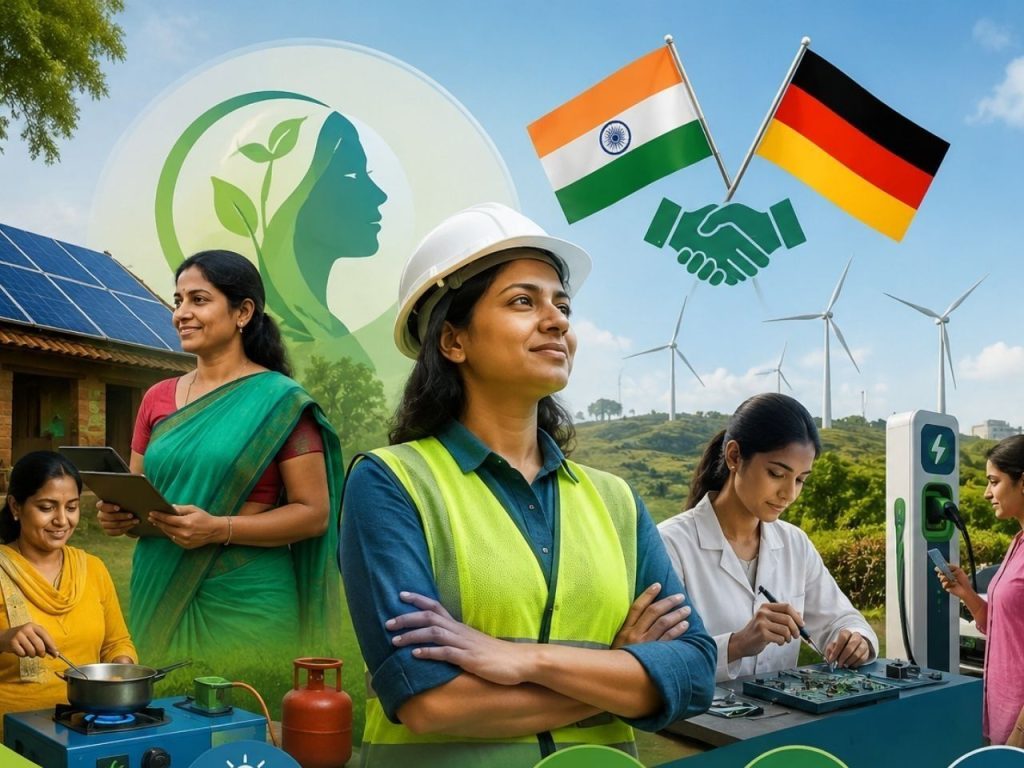
The latest edition of the India-Germany Climate Talks, hosted by the German Embassy in New Delhi, addressed the gap in recognising the critical role of women in shaping India’s clean energy transition. It highlighted the need to recognise women as innovators, entrepreneurs, researchers, community leaders, and decision-makers. The event also marked the launch of the book Powering the Future: Women at the Heart of India’s Energy Transition, authored by Neha Saigal, co-founder of Intertidal Lab and the Climate & Care Initiative, Bengaluru, and published by Heinrich Böll Stiftung (hbs), New Delhi. The book showcases the stories and experiences of women from Odisha, Punjab, Jharkhand, Maharashtra, and Tamil Nadu. It demonstrates how women are shaping India’s energy future while underscoring the need to integrate gender as a core pillar of climate and energy policy. Among the book’s key findings are stories of women from Odisha , Maharashtra, Punjab, Jharkhand, and Tamil Nadu who are at the centre of change as entrepreneurs powering rural livelihoods. It showcases women leveraging solar energy, innovators rethinking clean cooking, civic leaders advancing electric mobility, and communities navigating the uncertainties of coal-dependent regions. It also highlights the importance of embedding care and equity into institutions and policymaking. Women’s Growing Role in the EV Segment The book also highlights the growing role of women in the mobility segment. Based on its findings, women constitute just 0.03% of India’s transport workforce, and only 0.01% are engaged as licensed mobility service providers with relatively stable earnings and public visibility. Neha Saigal noted, “India’s energy transition presents an opportunity to place gender at the heart of policy and decision-making, not as an afterthought but as a foundation for a just transition. Women are central to energy systems as users, providers of care, and drivers of livelihoods, and their leadership and lived experiences must shape the transition. We need to move beyond speaking of a single ‘energy transition’ and recognise that India is experiencing multiple energy transitions, each shaped by local realities and the lived experiences of its communities. A just transition is not only about moving away from fossil fuels, but about ensuring we do not recreate existing inequalities as we build a cleaner energy future.” Despite this pronounced gender gap, most electric vehicle (EV) policies across India remain gender-neutral. Of the 27 state EV policies currently in place, only seven include initiatives specifically targeting women, while only Delhi and West Bengal explicitly provide provisions for women drivers. The Pink E-Auto Scheme in Amritsar directly responds to this structural imbalance within India’s transport and clean mobility sectors. Under the city’s Rejuvenation of Autorickshaws in Amritsar through Holistic Intervention (RAAHI) framework, gender inclusion was embedded within the local electric three-wheeler (e3W) policy architecture. The scheme established a formal pathway for women, particularly those from low-income and marginalised communities, to participate in the clean mobility economy through a 90% capital subsidy, structured training, and coordinated institutional support. The implementation process was deliberate and community-anchored. Punjab undertook sustained neighbourhood-level outreach, engaging nearly 300 women in structured discussions on licensing, safety, financing, and long-term viability. Introducing women as electric auto drivers into public spaces required careful trust-building and sustained engagement well before the formal rollout. Inclusive Climate Action Philipp Ackermann, Ambassador of the Federal Republic of Germany to India, highlighted the importance of inclusive climate action and the growing India-Germany partnership in advancing a just energy transition. “A gender-responsive energy transition is not just good for gender equality—it is an economic opportunity. Through the Indo-German Partnership for Green and Sustainable Development, India and Germany are not only advancing clean energy but also building a future that is people-centred, inclusive, and leaves no one behind.” Drawing on the newly launched publication, Neha Saigal discussed the experiences of women leading change across India’s energy landscape and the lessons these stories offer for building a more inclusive transition. Priyadarshini Karve shared insights from her work at the intersection of science, entrepreneurship, and decentralised renewable energy, highlighting the importance of expanding access to clean energy solutions while creating opportunities for women to lead innovation and enterprise. Speaking about the links between public health, clean mobility, and climate action, Amrita Rana discussed how community engagement and women’s leadership can accelerate cleaner transport solutions and improve air quality across Indian cities. Moderating the discussion, Jochen Luckscheiter noted that embedding gender-responsive approaches into energy planning, strengthening women’s participation across the clean energy value chain, and supporting local leadership will be critical to achieving a just and resilient transition.
Source: Read Full Article